Table of Contents
Video recording
Introduction
- Goal of the workshop: at the end you are going to give your partner a present. And it’s going to be the best present that person has ever received. This thanks to the fact that you will have learned how to successfully design products thanks to co-design.
- Participant pairs of people who don’t know each other too well work best for the assignments.
- Workshop duration: You need one hour to complete the process from the perspective of one person in the pair. With two hours both partners will have experiences the process.
Examples
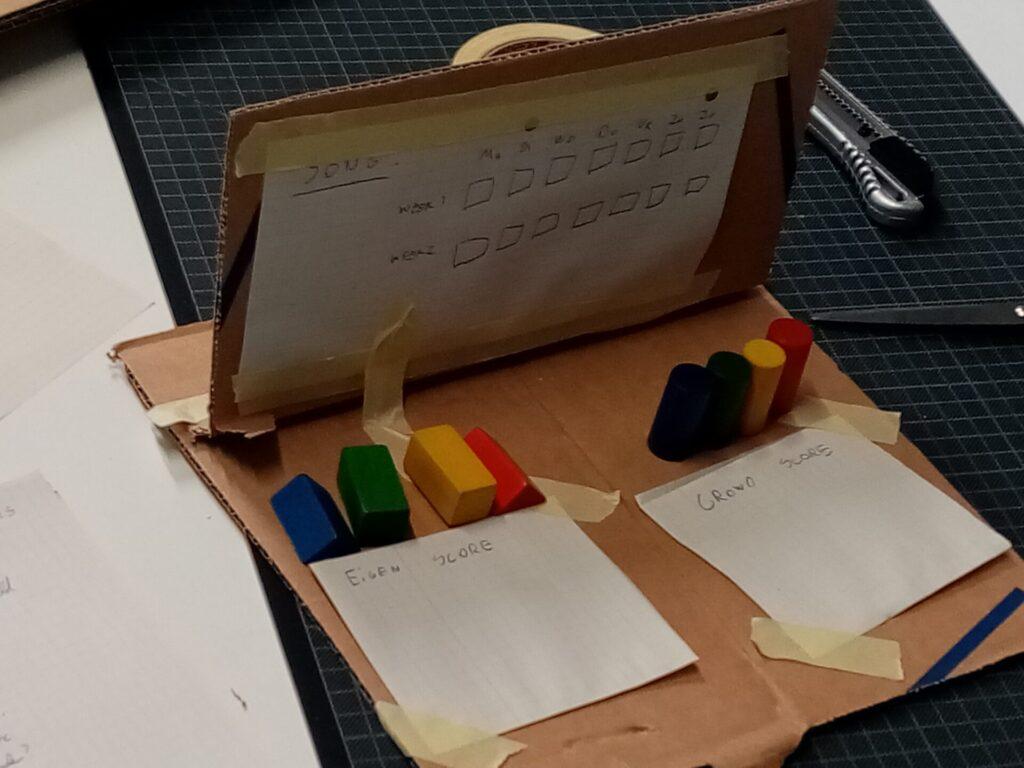
A solution was made to need of the participant to score their own karaoke performance, and to get a score from the crowd.
- The scores are given by throwing stuffed animals into a basket.
- The karaoke bar has a digital scoreboard which gets updated the moment that the stuffed animals are in the basket.
- The scoreboard offers a replay for each performance.
- The scoreboard is made tangible with a vertical standing piece of cardboard. This is taped to a second piece of cardboard laying flat
- Two basket is are represented by two pieces of paper.
- The stuffed animals are represented by wooden blocks of 3cm.
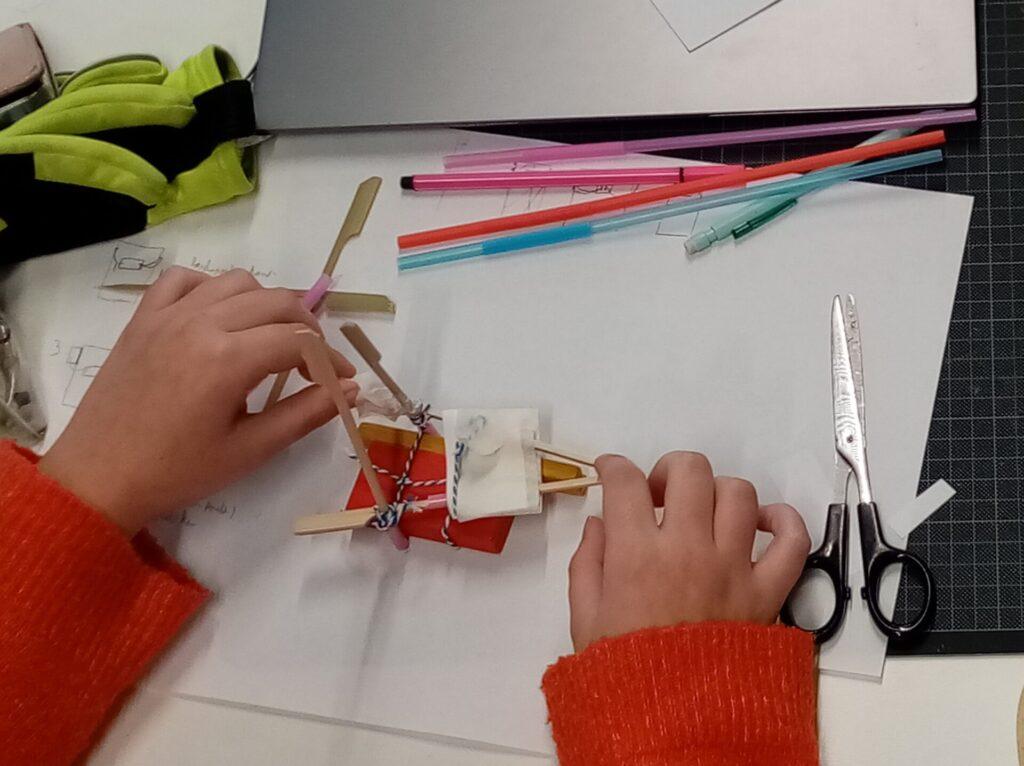
A solution was made as an answer the desire of the participant to quickly move across water, and to use the same solution to transform into a catapult on land.
- A combination of wooden skewers and rope were used to represent the vehicle.
- A piece of tape was used as the sail which transforms into a catapult.
Worksheet
Insert two documents for download:
- Worksheet design with visually impaired users, not for them.docx
- Worksheet design with visually impaired users, not for them.pdf
Interested in the science behind the workshop?
An assistive device which does not meet an individuals needs results in less or no use of the assistive device and a decrease in the quality of life. Often this is the result of not including the product end-users, also known as the target group, during the design process.
Co-design is a collaborative approach where product end-users, also known as the target group, work with designers to create solutions for their needs. The majority of theory on effective co-design doesn’t take into account the abilities of people with a visual impairment.
With this workshop we give an introduction to effective product design.
So, what’s the process you’ve done during the workshop?
- In the first part, you open up your thinking: You collect lots of information, and look at the situation from different points of view. Then you narrow your focus and decide what the real problem is that needs to be solved.
- In the second part, you again open up your thinking. You come up with many different ideas and possible solutions. After that, you narrow your focus again and choose the solution that works best.
This is often referred to as the “double diamond”. It’s visualised as two rectangles placed next to each other, angled 90 degrees, overlapping and connected. This gives the look of two diamonds.
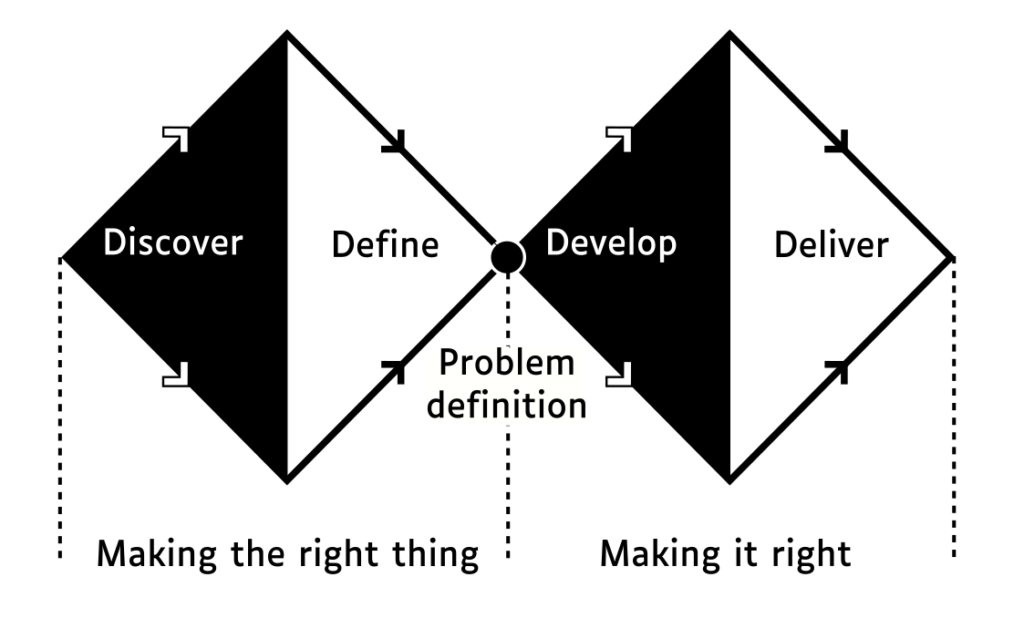
Modified version of the The Double Diamond by the Design Council, licensed under a CC BY 4.0 license
We would also like to thank Barkins D. for his publication Accessible Design: Exploring the Ideation and Sketching Process with Blind/Low-Vision Individuals (2021).
In 2021 Barkins’ investigated how to create an inclusive and accessible environment for sketching and ideating for blind and low-vision designers. We included some of the tips shared by his participant in the worksheet. Also, a part of the material list was inspired by his article.
Funded by the European Union. Views and opinions expressed are however those of the author(s) only and do not necessarily reflect those of the European Union or Epos vzw. Neither the European Union nor the granting authority can be held responsible for them.